GoodReads

C's bookshelf: read

The Peculiar
Maggot Moon
Chime
Leviathan
The City and the City
Graceling
The Road
A Certain Slant of Light
The Muses Among Us: Eloquent Listening and Other Pleasures of the Writer's Craft
Persepolis: The Story of a Childhood
Brown Girl in the Ring
Well Wished
The Innkeeper's Song
Understanding Comics: The Invisible Art
Beloved
American Indian Myths and Legends
The Left Hand of Darkness
The Return of the King
The Fellowship of the Ring
The Two Towers


C S Peterson's favorite books »
Showing posts with label Favorite Things. Show all posts

Saturday, March 2, 2013

On Watching the Spring Come In


When the children were small we went on nature walks every week from January to May deep in the Connecticut woods.  
Our friendly neighborhood naturalist, Ronnie Kamphausen, would help us find vernal ponds filled with tadpoles, turn over logs to find salamanders and peek in the speckled red spathes of skunk cabbage, the secret hiding places of bees caught out on a cold spring night.  We moved to Colorado and reveled in the prairie and the mountains but somehow got too busy to just watch each week to see the spring creep in, until now.  
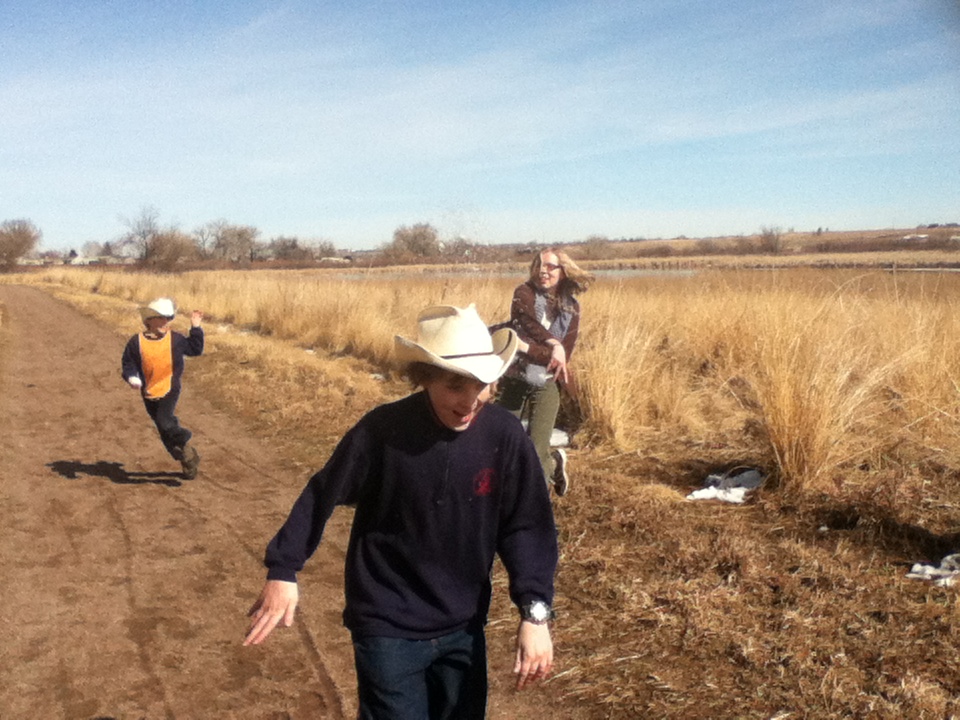
Today we took the first of what I hope will be weekly spring walks near our house to watch for the change of the season.  We saw ducks on the pond, a kestrel in a tree and prairie dogs chirping alarms. We threw snow at each other and covered our boots in mud.  It was glorious.  
Each of us brought some small thing home to sketch as well.  We were inspired to do this by my friend Ruth Ann Olson, who writes a blog about her small farm (http://www.lillabondgard.blogspot.com/).  When she was a young schoolgirl in England they would go for a walk each day and every student was expected to bring back some small thing to draw.

So here is to spring as it slowly comes in and seeing the magic as it happens!

Friday, March 16, 2012

She caught her breath in amazement...


Friday was a journey through the middle ages - one of my favorite topics to work on with students. I really wish I had a time machine, but we come as close as we can. 
First stop was the Cathedral of St. John in the Wilderness in downtown Denver. It is an Episcopal church built from 1906 to 1911 in the gothic style. We sat out in the garden and looked at the outside. We talked about the fall of Rome and romanesque style arches, the rediscovery of Plato, how the parable of the cave was reinterpreted through a Christian lens and how this influenced gothic style. I asked my students to think about what daily life for a medieval peasant was like. I asked the students to pay attention to how they felt when they walked into the Cathedral and notice where there eyes looked first. It was a lot of talk. My students diligently drew little maps of the Mediterranean and took notes. 
Then we walked into the Cathedral.  
I must admit, I get such a nice feeling of satisfaction when I hear the students catch their breath in amazement.
“Up!” said one student in a hushed voice, “they want you to look up!”
“Look at all the light!” said another.
“It’s so much bigger inside!” exclaimed a third in an awed whisper.
We spread out a copy of the Hereford Mappa Mundi from the 13th century on the floor in the middle of the transept and talked about how the educated people of western Europe pictured themselves and their place in the world at that moment in time. We climbed the circular stairs in a tower to the choir loft. We looked through arrow slit windows. We talked about the vulnerabilities of castles and surviving a siege. We went to the library and held the leaves of illuminated manuscripts handwritten on vellum. We finished at the art museum looking at changes in style from the 13th to the 16th centuries. We talked about what people will think of us seven centuries from now. 
It was an amazing day. 
But it was that moment, when they caught their breath, that the experience of another time became real for my students. 
That is my favorite thing.

Thursday, March 15, 2012

Book at Dawn - Perfect Moment


I got up early - determined to go swimming and get back on track after a week that knocked me flat. But I was caught by a book. It was the ending of a book actually, that had caught me earlier in the week.  “When You Journeyed Homeward” by Cynthia Kennedy, embodies the solitude of a mountain trek. It is the memoir of a young wife, caring for her husband, after he has been injured climbing Cho Oyu in Nepal. The book is filled with quiet, agonizing vulnerability as they travel along together to discover if their marriage will survive. By the end I had a new understanding of why humans would endure such pain - some to summit peaks and some to write poems. I lay in my warm bed, next to my softly snoring husband, watching the sun rise and relishing the peace of the last few pages. I’ll go swimming tomorrow.

Wednesday, March 7, 2012

Dreaming of My Father's Violin


Dreaming of the smell of my fathers violin
rosin and dust
sharp tang of a spare string
silent, I run my fingers 
across the blue velvet
On his desk
the waxy slice of agate that lay
long after his coffee mug was gone
strips of gold and umber
a tiny crystalled gap
between the layers

dawn creeps slow along 
strips of grey and cream
backing the fading twinkle of horizon lights
the house still asleep
on my computer
I play a boys choir 
singing christmas carols
even though it is March
while, out my dark window, 
a bus trundles lonely down the street


Friday, October 7, 2011

An October Sestina: Garden


A sestina I wrote when our youngest was five months old...


Garden

An October blue-sky golden walk in my garden
Bare feet, cooling ground, warm sun on my skin,
Snapping basil stems, overflowing armloads crush up into my face.
The scent overwhelms.  Perfect tomatoes fill my hands
With sun soaked heat.  I rub off the crust
Of honest dirt and carry all inside dreaming of olive oil

The jar is empty.  I pad down cool stairs for more oil.
The kitchen table overflows with garden
Treasure.  Visions dance – something with a golden crust
Of cheese.  On the counter dough rises in a mound smooth as baby skin.
Curving it out of the bowl, I pull and stretch.  Husband puts his hands
On my shoulders.  I brush my eye and trace my face

With flour.  I wipe my hands and turn to face
Him with a kiss.  “If you want to help sit and oil
The pans.”  So he sits and works.  I shape and stretch.  He hands
Me oiled pans.  I slip in the loaves and go back out to the garden
for the eggplant I just saw from the window, purple skin
Gleaming.  Grilled, I think, with a little parmesan, to give it a nice crust.

The kids made sugared grapes – luscious rounds coated with a crust
Of sparkling hoarfrost.  I slice warm bread, drizzle garlic butter on the face
Of each piece and set it on the table.  Husband peels the wax skin
Off the cheese. I scrub the cast iron skillet then wipe it with oil
Till it gleams.  Husband opens the door to call the kids in from the garden.
They spill in with the slanting sun.  I tell them to wash their hands.

At my chair the sleeping cradled baby’s hands
Curl open like petals.  The sunlight halos his head and a crust
Of milk has dried on his cheek.  We look ‘round the table at our garden,
Full of impatient life, the evening sun glowing on each face.
Suddenly I see I live with heedless saints who, all unknowing, pour the oil
Of their spirits over my rough heart and salve my chaffed skin.

I take out the garbage and freezing rain pierces my shocked skin.
Husband clears the dishes while upstairs I fill my hands
With washrag and soapy child.  Husband creeps up and daubs my neck with bath oil.
Inside we thickly mulch each child with blankets, outside ice forms a crust
On muddy puddles.  In the warm bed Husband’s beard tickles my face.
Ice rain scatters and pebbles against the window.  I dream of the garden.

In my dream a new garden breaks through the crust
Of a bare earth.  Fresh oil like sunlight drenches my skin
And I lay the curves of my face in warm and tender hands

Sunday, August 7, 2011

Alien Life

By the time I was in fourth grade I had decided what I wanted to be when I grew up, an exobiologist.  I was elated by this decision.  I felt that the great question of my purpose in life had finally been settled.  It didn’t occur to me that it might be less than obvious to the other people in my world why this was such an obvious choice for my vocation, much less that others might not even know what exobiology was.  I told my two best friends and received only blank expressions.  I gave my most enthusiastic explanation, still blank faces. I thought my fourth grade teacher, Mrs. Bannock, would provide a better reaction.  I told her, she was very enthusiastic and I was delighted.
            “Dinosaurs are one of my favorite things to study as well!” she said.
            I was crushed.  In desperation I even told my father, who pointed out that there wasn’t anything, actually, to study yet and probably wouldn’t be for some time.  I saw the sense in what he said and ran away to join the circus.  So ended my brief career as an exobiologist.

Now days we call the field Astrobiology and NASA has a whole institute devoted to the study of alien life.  O.K. we haven’t actually found any yet, BUT in the last twenty years we have found liquid water in the most unexpected places in our solar system and we have found life in some very unexpected places on our planet.  Now my eleven-year-old son has got the astrobiology bug (so to speak) and we recently went to listen to a current astrobiologist, Dr. Benner, give a lecture at the museum in Denver.

On the drive there my son and I talked about what life is, exactly, and tried to hammer out a simple definition.  To my delight Dr. Benner spent much of the first half of his lecture talking about the philosophy of science and the difficulty of constructing a theory of life without bias.  He handed out a number of rocks and asked the audience to determine which ones showed evidence of life.  He talked about the human propensity to look for patterns – and see patterns, even if no patterns really exist.  He talked about constructive belief and how that influences the design of experiments meant to look for life.  He talked about theories that operated under the assumptions that life must: metabolize oxygen or carbon dioxide, fix carbon, be a cell, have our kind of DNA, make protein, have a minimum volume.

Good scientists, he warned, must continually check themselves and each other, examining the sources of assumptions.  Thinking outside the box with integrity is very hard work.

The rest of the lecture was filled with wonders.  We have made so many amazing discoveries about life just on our own planet, past and present.  The quest of astrobiologists has spawned whole new fields: paleogenetics, synthetic biology, computational bioinformatics and the intense study of extreamophiles.  Experiments related to the search for life are on board many of the missions we plan to send off into space over the next fifty years.  Mars is exciting, of course, but so are moons I had never heard of in my fourth grade enthusiasm: Europa, Enceladus and Titan.  What a great time to be alive!

On the car ride home I was waxing philosophical, relating Plato’s parable of the cave and connecting it to the thoughts on the philosophy of science Dr. Brenner had shared.  I was really on a roll when my son interrupted me.
            “Mom,” he said, “I really like synthetic biology.  I think you should help me learn organic chemistry next.”
            I didn’t have the heart to tell him that organic chemistry was the only class I ever had to drop in college because I just couldn’t hack it.  Isn’t life ironic? I heard my mother’s voice: “I hope you have four just like you!”   

Sunday, April 10, 2011

S.A.M.E. Cafe


On Thursday I went to the Denver TED event with my oldest daughter and some friends from work.
TED is a conference where amazing brilliant people get up on stage and have eighteen minutes to talk about their best idea.  Then TED posts video of these presentations on the Internet for the world to see.  We all knew one of the presenters.  She was a teacher at our school, but left to open a restaurant with her husband.  I was so excited for her.  And I was star struck too!  I couldn't help telling anyone I was sitting next to, or chatting with during the breaks, that I knew her and that she, her husband and their restaurant really are as amazing as they sound.  Here is what they do:  People come and eat and pay what they think is fair or what they can.  People are welcome to volunteer to help with the cooking and washing up.  They have built a community in and around this restaurant where everyone is treated with dignity.  People from the neighborhood, people who are homeless, business people, all sit down and eat a delicious, healthy organic lunch together in a beautiful environment.  It is a miracle they have all worked very hard to make together.  Her name is Libby Birkey and the name of the restaurant is the S.A.M.E. Cafe (Stands for: So All May Eat).  I can't wait to see her video on the TED website!

Thursday, March 31, 2011

Appreciation

Wow!  What a wonderful thing this slice of life challenge has been!  I began with great trepidation, thinking “How am I going to fit in time to write every day?  I’m such a slow writer and I have no time as it is! And who would want to read anything I write anyway?”  But with encouragement from my friend, Linda, who showed me how to set up a blog, I started.  And now it’s finished!  And  I  am going to miss this community of writers and reading the daily snapshot of life on our planet that we create together.  What an antidote to the news you all have been; what a revelation, what a joy and a wonder it has been to read what you have written. Thank you!  Thank you!

 I think now I have a writing habit – and I will still sit here, in the pearl grey dawn of the mornings, writing.  I have new hope - maybe I will finish that novel! :-) Linda tells me that there is a Tuesday slice of life through the year, so we can wave at each other once a week.  I hope to see you all there!

And since today is the first day of poetry month, I would like to share one of my favorite poems:

Voyage
By Tony Hoagland


I feel as if we opened a book about great ocean voyages
And found ourselves on a great ocean voyage:
Sailing through December, around the horn of Christmas
and into the January Sea, and sailing on and on

in a novel without a moral but one in which
all the characters who died in the middle chapters
make the sunsets near the book's end more beautiful.

and someone is hanging a lantern from the stern,
and someone else says, "I'm only sorry
that I forgot my blue parka; It's turning cold."

Sunset like a burning wagon train
Sunrise like a dish of cantaloupe
Clouds like two armies clashing in the sky;
Icebergs and tropical storms,
That's the kind of thing that happens on our ocean voyage —

And in one of the chapters I was blinded by love
And in another, anger made us sick like swallowed glass
& I lay in my bunk and slept for so long,

I forgot about the ocean,
Which all the time was going by, right there, outside my cabin window.

And the sides of the ship were green as money,
and the water made a sound like memory when we sailed.
Then it was summer. Under the constellation of the swan,
under the constellation of the horse.

At night we consoled ourselves
By discussing the meaning of homesickness.
But there was no home to go home to.
There was no getting around the ocean.
We had to go on finding out the story
                                                by pushing into it —

The sea was no longer a metaphor.
The book was no longer a book.
That was the plot.
That was our marvelous punishment.