GoodReads

C's bookshelf: read

The Peculiar
Maggot Moon
Chime
Leviathan
The City and the City
Graceling
The Road
A Certain Slant of Light
The Muses Among Us: Eloquent Listening and Other Pleasures of the Writer's Craft
Persepolis: The Story of a Childhood
Brown Girl in the Ring
Well Wished
The Innkeeper's Song
Understanding Comics: The Invisible Art
Beloved
American Indian Myths and Legends
The Left Hand of Darkness
The Return of the King
The Fellowship of the Ring
The Two Towers


C S Peterson's favorite books »
Showing posts with label Memoir. Show all posts

Saturday, March 2, 2013

On Watching the Spring Come In


When the children were small we went on nature walks every week from January to May deep in the Connecticut woods.  
Our friendly neighborhood naturalist, Ronnie Kamphausen, would help us find vernal ponds filled with tadpoles, turn over logs to find salamanders and peek in the speckled red spathes of skunk cabbage, the secret hiding places of bees caught out on a cold spring night.  We moved to Colorado and reveled in the prairie and the mountains but somehow got too busy to just watch each week to see the spring creep in, until now.  
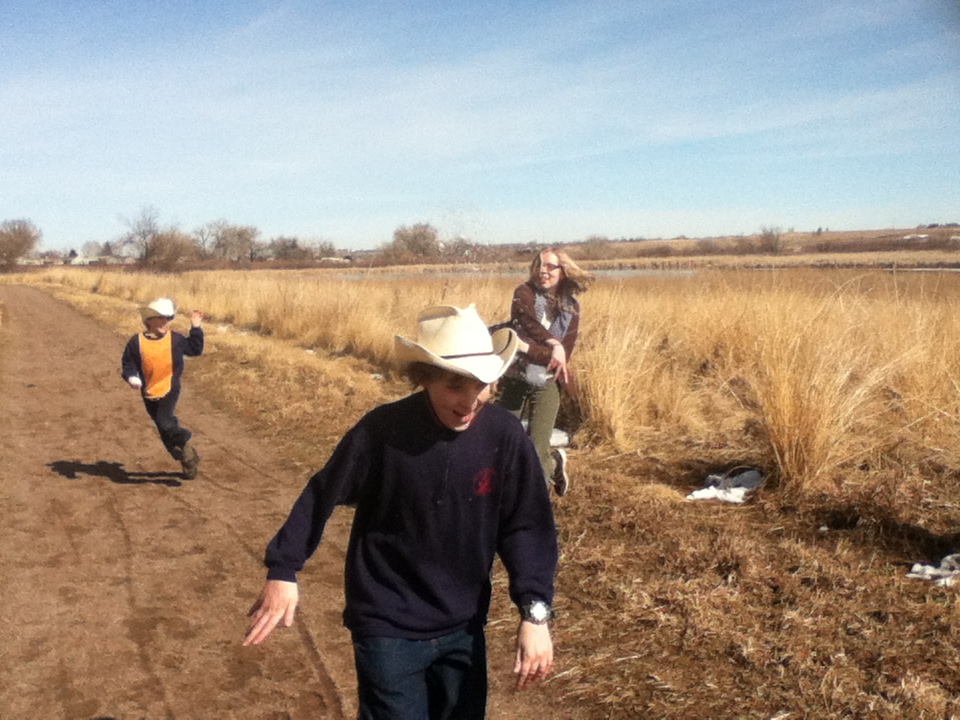
Today we took the first of what I hope will be weekly spring walks near our house to watch for the change of the season.  We saw ducks on the pond, a kestrel in a tree and prairie dogs chirping alarms. We threw snow at each other and covered our boots in mud.  It was glorious.  
Each of us brought some small thing home to sketch as well.  We were inspired to do this by my friend Ruth Ann Olson, who writes a blog about her small farm (http://www.lillabondgard.blogspot.com/).  When she was a young schoolgirl in England they would go for a walk each day and every student was expected to bring back some small thing to draw.

So here is to spring as it slowly comes in and seeing the magic as it happens!

Friday, March 9, 2012

Farting Birth Stories


I’m so lucky! We have a professional day today. So over this weekend another teacher has graciously let me cut in line and check out “Wonder.” I started reading it aloud to my boys, 8 and 10, last night. We made it as far as August’s birth story. The author is brilliant. The birth story is full of farts.
My boys were rolling on the ground, laughing, tears streaming from their eyes. Many fart noises were made in armpits. Then:
“Mommy, did your nurse fart when I was born?” said the 10 yr old.
“I don’t remember.”
“I was born in the kitchen, right?”
“Yes, we had rented a hot tub and put it in the kitchen. But I was uncomfortable. The sides of the tub were soft and I couldn’t brace myself against it to push you out. So Mary Ellen, the midwife, helped me get out. Then I sat down by the wood stove and I told Mary Ellen ‘I don’t think I can do this anymore.’ and she said ‘Oh yes you can!’ and out you came!”
“Then what did Daddy do?”
“Well, Daddy sat on the couch holding you while I got cleaned up. He kept saying - 
‘You are so born! Yes born is what your are! You are so born...so born!’
“What about me?” asks the 8 yr old
“We were in a hospital...”
“But it was one with a hot tub, it had a hot tub.”
“Yes I stayed in the hot tub. Your sister was holding my hand and telling me to push and then you kind of swam up.”
10 yr old chimes in “You  must have thought ‘nice of them to build an addition! It was getting kind of cramped in there!’
Both boys start laughing again. 10 yr old snorts.
“Yes,” I say, “but then you hit the air and you were not happy!”
8 yr old does his best impression of an unhappy newborn. He’s pretty good!
I marvel again at the power of stories and the magic of writing. We can look at a piece of paper and hear the voice of another separated from us in space and time. Amazing!
Today, on our professional day, we field trip teachers are taking a group of core teachers on a field trip to the main branch of the Denver Public Library. Special collections, amazing new resources in the building and on the internet, and stories, stories, stories! Who wouldn’t want to go?

Wednesday, March 7, 2012

Dreaming of My Father's Violin


Dreaming of the smell of my fathers violin
rosin and dust
sharp tang of a spare string
silent, I run my fingers 
across the blue velvet
On his desk
the waxy slice of agate that lay
long after his coffee mug was gone
strips of gold and umber
a tiny crystalled gap
between the layers

dawn creeps slow along 
strips of grey and cream
backing the fading twinkle of horizon lights
the house still asleep
on my computer
I play a boys choir 
singing christmas carols
even though it is March
while, out my dark window, 
a bus trundles lonely down the street


Friday, October 7, 2011

An October Sestina: Garden


A sestina I wrote when our youngest was five months old...


Garden

An October blue-sky golden walk in my garden
Bare feet, cooling ground, warm sun on my skin,
Snapping basil stems, overflowing armloads crush up into my face.
The scent overwhelms.  Perfect tomatoes fill my hands
With sun soaked heat.  I rub off the crust
Of honest dirt and carry all inside dreaming of olive oil

The jar is empty.  I pad down cool stairs for more oil.
The kitchen table overflows with garden
Treasure.  Visions dance – something with a golden crust
Of cheese.  On the counter dough rises in a mound smooth as baby skin.
Curving it out of the bowl, I pull and stretch.  Husband puts his hands
On my shoulders.  I brush my eye and trace my face

With flour.  I wipe my hands and turn to face
Him with a kiss.  “If you want to help sit and oil
The pans.”  So he sits and works.  I shape and stretch.  He hands
Me oiled pans.  I slip in the loaves and go back out to the garden
for the eggplant I just saw from the window, purple skin
Gleaming.  Grilled, I think, with a little parmesan, to give it a nice crust.

The kids made sugared grapes – luscious rounds coated with a crust
Of sparkling hoarfrost.  I slice warm bread, drizzle garlic butter on the face
Of each piece and set it on the table.  Husband peels the wax skin
Off the cheese. I scrub the cast iron skillet then wipe it with oil
Till it gleams.  Husband opens the door to call the kids in from the garden.
They spill in with the slanting sun.  I tell them to wash their hands.

At my chair the sleeping cradled baby’s hands
Curl open like petals.  The sunlight halos his head and a crust
Of milk has dried on his cheek.  We look ‘round the table at our garden,
Full of impatient life, the evening sun glowing on each face.
Suddenly I see I live with heedless saints who, all unknowing, pour the oil
Of their spirits over my rough heart and salve my chaffed skin.

I take out the garbage and freezing rain pierces my shocked skin.
Husband clears the dishes while upstairs I fill my hands
With washrag and soapy child.  Husband creeps up and daubs my neck with bath oil.
Inside we thickly mulch each child with blankets, outside ice forms a crust
On muddy puddles.  In the warm bed Husband’s beard tickles my face.
Ice rain scatters and pebbles against the window.  I dream of the garden.

In my dream a new garden breaks through the crust
Of a bare earth.  Fresh oil like sunlight drenches my skin
And I lay the curves of my face in warm and tender hands

Sunday, August 7, 2011

Alien Life

By the time I was in fourth grade I had decided what I wanted to be when I grew up, an exobiologist.  I was elated by this decision.  I felt that the great question of my purpose in life had finally been settled.  It didn’t occur to me that it might be less than obvious to the other people in my world why this was such an obvious choice for my vocation, much less that others might not even know what exobiology was.  I told my two best friends and received only blank expressions.  I gave my most enthusiastic explanation, still blank faces. I thought my fourth grade teacher, Mrs. Bannock, would provide a better reaction.  I told her, she was very enthusiastic and I was delighted.
            “Dinosaurs are one of my favorite things to study as well!” she said.
            I was crushed.  In desperation I even told my father, who pointed out that there wasn’t anything, actually, to study yet and probably wouldn’t be for some time.  I saw the sense in what he said and ran away to join the circus.  So ended my brief career as an exobiologist.

Now days we call the field Astrobiology and NASA has a whole institute devoted to the study of alien life.  O.K. we haven’t actually found any yet, BUT in the last twenty years we have found liquid water in the most unexpected places in our solar system and we have found life in some very unexpected places on our planet.  Now my eleven-year-old son has got the astrobiology bug (so to speak) and we recently went to listen to a current astrobiologist, Dr. Benner, give a lecture at the museum in Denver.

On the drive there my son and I talked about what life is, exactly, and tried to hammer out a simple definition.  To my delight Dr. Benner spent much of the first half of his lecture talking about the philosophy of science and the difficulty of constructing a theory of life without bias.  He handed out a number of rocks and asked the audience to determine which ones showed evidence of life.  He talked about the human propensity to look for patterns – and see patterns, even if no patterns really exist.  He talked about constructive belief and how that influences the design of experiments meant to look for life.  He talked about theories that operated under the assumptions that life must: metabolize oxygen or carbon dioxide, fix carbon, be a cell, have our kind of DNA, make protein, have a minimum volume.

Good scientists, he warned, must continually check themselves and each other, examining the sources of assumptions.  Thinking outside the box with integrity is very hard work.

The rest of the lecture was filled with wonders.  We have made so many amazing discoveries about life just on our own planet, past and present.  The quest of astrobiologists has spawned whole new fields: paleogenetics, synthetic biology, computational bioinformatics and the intense study of extreamophiles.  Experiments related to the search for life are on board many of the missions we plan to send off into space over the next fifty years.  Mars is exciting, of course, but so are moons I had never heard of in my fourth grade enthusiasm: Europa, Enceladus and Titan.  What a great time to be alive!

On the car ride home I was waxing philosophical, relating Plato’s parable of the cave and connecting it to the thoughts on the philosophy of science Dr. Brenner had shared.  I was really on a roll when my son interrupted me.
            “Mom,” he said, “I really like synthetic biology.  I think you should help me learn organic chemistry next.”
            I didn’t have the heart to tell him that organic chemistry was the only class I ever had to drop in college because I just couldn’t hack it.  Isn’t life ironic? I heard my mother’s voice: “I hope you have four just like you!”   

Sunday, April 3, 2011

Buzz and My Dad

I’ve been watching and listening, online, to people speaking about education.  I’m hearing this buzz:

The public education system we have, essentially worldwide thanks to 19th century colonialism, was designed to educate children to be adults who could function productively in a world that was in the midst of rapid change from agrarian to industrialized.  The world is again changing rapidly because of the current Cambrian explosion of technology, but the school system is still educating for the 19th century.  This inability of the current educational system to evolve is structural and entrenched, the buzz says, and those that don’t get this, and respond by finding ways to evolve intelligently into a system that does educate for the now that actually is, will watch their economies and their power dwindle.

I wonder if others are hearing the same buzz?  What do you think?

            My father, who passed away recently, was an educational visionary.  In 1965 he was working at Stanford on “computer assisted instruction.”  I used to visit him at work. I enjoyed tagging along with the man who constantly moved about the computer rooms with his shopping cart full of cathode ray tubes.  It was very loud.  But the best thing was when my dad sat me down at the computer.  He put earphones on my head.  They were so large that they covered the entire side of my face.  Then a lady’s voice:
            “Draw a line from the boy to the bicycle,” she instructed.
            I took the white stylus, with a cord attached to its end, and placed it on the flickering green cartoon of a boy.  I drew an imaginary line from him to the flickering green cartoon of the bicycle. Oh!  The boy walked to the bicycle, got on, and rode it off the screen!  I did the same with the girl and the ice cream cone. I could have sat there for hours.  My dad thought that computers might be a powerful way to enhance education, but he met with a lot of resistance in 1965.
            In the last months of his life my dad became confused about time.  One day he woke up from his nap, ready to work again on the problem of making computers effective learning tools.  It was just he and I in the house for the afternoon.  We talked for quite a while, and I tried to keep up with when we were, as he discussed the problems he and his team were having with getting enough computing memory and the challenges of designing a program that could be instantaneously individualized for millions.  Eventually we made our way into his study and got on the Internet on my parent’s computer.  I showed him the interactive games I use with my math students. We played a few and he was delighted.  We poked around on wikipedia and I tried to explain how people all over the world could write articles.  I even showed him how to translate an article on Bach, written in German, instantly into English.  He was amazed.  Finally I showed him his book on Amazon, and the reviews people had written.  He was very surprised.
            “But that book was written for another world,” he exclaimed, “It’s so out of date!”
            We surfed some more, but I could tell he was getting tired.
            “Those mathematics games we were working with, did you write those?”
            “No dad, I just use them in class.”
            “Are they expensive?”
            “No dad, they’re free.  They are on the Internet and anyone with a computer can use them.”
            He leaned back comfortably in his chair with a contented sigh.
            “Well that is good,” he said, as he began to drift off. “Now teachers can be freed from all the paperwork of drilling and testing and available to nurture their student’s souls.”